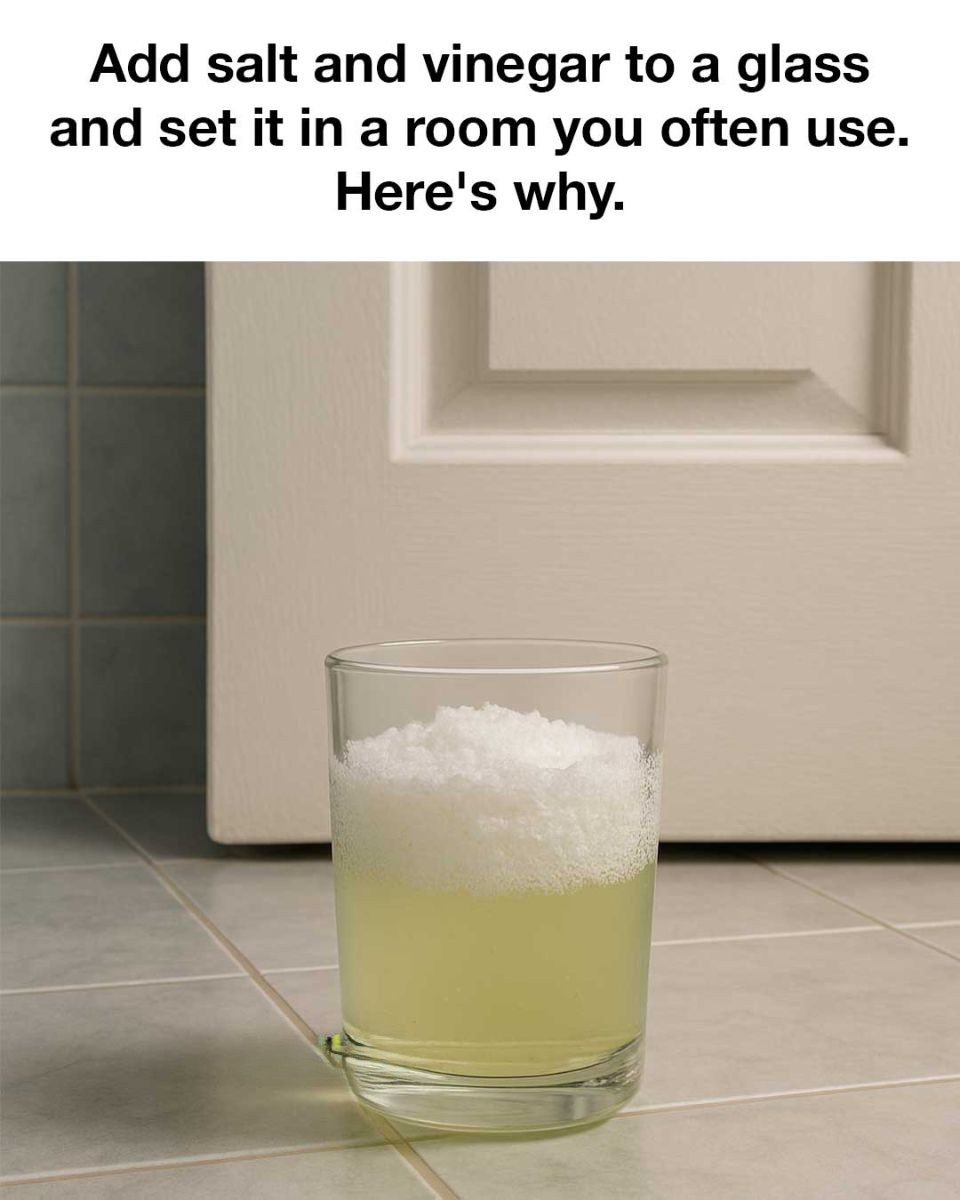
Add Salt and Vinegar to a Glass and Set It in a Room You Often Use—Here’s Why
🌍 6. Viral Hacks: Other Uses for Salt & Vinegar
Salt and vinegar are also trending in other DIY hacks:
Natural cleaner for sinks, tubs, and tile grout
Limescale remover for kettles, faucets, and showerheads
Pest deterrent (e.g., for ants)—vinegar disrupts scent trails, and salt can deter entry
Their combined cleaning, purifying, and deodorizing properties make them a go-to pair in many households.
🔬 7. What Does Science Say?
While there’s limited direct research on salt and vinegar as air purifiers, their individual benefits are well-documented:
Acetic acid (vinegar): Proven antimicrobial against E. coli, salmonella, and some viruses on surfaces
Salt (sodium chloride): Known for its moisture-absorbing (hygroscopic) properties, used in dehumidifiers and air purifying lamps
✅ Though more studies are needed on airborne effects, the foundational science supports their use as a mild, natural purifier.
⚠️ 8. Potential Drawbacks and Limitations
Vinegar smell: Some find it harsh or unpleasant (can be softened with citrus peels or essential oils).
Limited scope: Won’t capture microscopic airborne particles like HEPA filters do.
Not a substitute for ventilation, cleaning, or professional air purifiers in homes with high allergen loads or pollution.
This method is best used as a supplement, not a replacement, for comprehensive indoor air care.
🆚 9. Natural vs. Commercial Air Purifiers
| Feature | Salt & Vinegar | Commercial Purifiers |
|---|---|---|
| Cost | Very low (kitchen staples) | High upfront and maintenance costs |
| Chemical-free | ✅ Yes | ❌ Often contains plastics/filters |
| Removes fine particles | ❌ Not effectively | ✅ Yes (e.g., HEPA) |
| Neutralizes odors | ✅ Effectively | ✅ More thoroughly |
| Adds natural scent | ✅ Vinegar-based | ❌ Often artificial scents |
Bottom line: If you’re looking for a low-cost, low-effort supplement to freshen air and reduce humidity, salt and vinegar is a solid choice.
🌟 10. Real-Life Testimonials
“I started placing a glass of vinegar and salt in the kitchen, and within hours, the lingering cooking smell was gone.” — Lena G., Texas
“I use it in the bathroom. It helps cut that damp, musty smell—and I like knowing it’s not full of chemicals.” — Mark R., New York
These firsthand stories echo the growing trend of turning to natural solutions for everyday home needs.
❓ 11. Frequently Asked Questions
Q: Does the vinegar smell linger?
A: It may be strong at first but usually fades as it evaporates—leaving the air fresher.
Q: Can I use apple cider vinegar instead?
A: Yes, though it has a stronger scent and may color surfaces. White vinegar is preferred for neutrality.
Q: How often should I change the mixture?
A: Every 3–5 days, or once the vinegar scent fades.
Q: Is it safe around pets?
A: Keep the container out of reach. Vinegar isn’t toxic in small amounts but may irritate sensitive pets.
🌱 Final Thoughts: Small Change, Big Impact
A simple glass of salt and vinegar can do more than you might think—it can absorb moisture, neutralize lingering odors, and offer a chemical-free alternative to artificial air fresheners.
While it’s not a miracle solution, it’s a low-effort, low-cost way to support a cleaner, more comfortable home. Sometimes, the most effective solutions really are the simplest.
